Quaking Aspen
Populus tremuloides
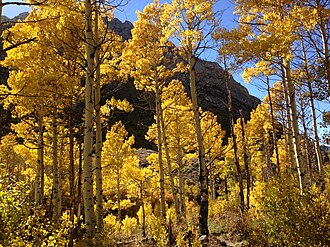
The most widespread tree in North America, famed for white bark and fluttering leaves that turn the mountainsides gold in fall. A single clonal grove can be among the largest organisms on Earth. The inner bark and spring sap are traditional famine foods, dried into flour or drunk fresh; both contain aspirin-like salicylates, so those with ulcers should avoid them.
- Family
- Salicaceae
- Type
- tree
- Lifespan
- perennial
- Height
- 20–50 ft
- Spacing
- 10–30 ft apart
- Light
- sun, part shade, shade
- Soil moisture
- dry, moist
- Soil pH
- acidic, neutral, alkaline
- Bloom
- March, April, May, June
- Bloom colors
- yellow, green, brown
- Wildlife value
- songbirds, butterflies, larval host
- Caterpillar hosts
- ~367 butterfly & moth species
- Landscape uses
- specimen
- Native states
- AK, AZ, CA, CO, CT, IA, ID, IL, IN, MA, MD, ME, MI, MN, MO, MT, NC, ND, NE, NH, NJ, NM, NV, NY, OH, OR, PA, RI, SD, TX, UT, VA, VT, WA, WI, WV, WY
Related native plants
More Populus species
- Eastern Cottonwood (Populus deltoides)
- Fremont Cottonwood (Populus fremontii)
- Bigtooth Aspen (Populus grandidentata)
- Black Cottonwood (Populus trichocarpa)
- Narrowleaf Cottonwood (Populus angustifolia)
- Balsam Poplar (Populus balsamifera)