Common Milkweed
Asclepias syriaca
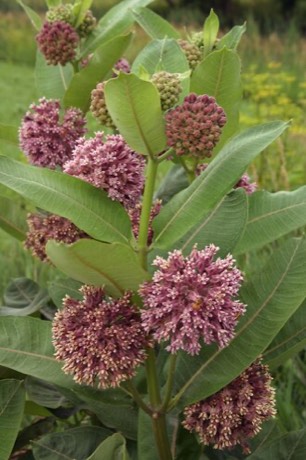
Most familiar monarch host. Spreads aggressively by rhizomes. Young shoots, unopened flower buds, and immature seed pods are traditional cooked vegetables (an asparagus and okra substitute, respectively) — all parts should be well cooked, never raw.
- Family
- Apocynaceae
- Type
- wildflower
- Lifespan
- perennial
- Height
- 2–3 ft
- Spacing
- 0.75–1 ft apart
- Light
- sun
- Soil moisture
- moist
- Soil pH
- alkaline
- Bloom
- June, July, August
- Bloom colors
- white, purple
- Wildlife value
- butterflies, larval host, monarch host
- Caterpillar hosts
- ~12 butterfly & moth species
- Landscape uses
- naturalizing
- Native states
- AL, AR, CT, DC, DE, IA, IL, IN, KS, KY, LA, MA, MD, ME, MI, MN, MO, MS, NC, ND, NE, NH, NJ, NY, OH, OK, OR, PA, RI, SC, SD, TN, TX, VA, VT, WI, WV
Related native plants
More Asclepias species
- Butterfly Weed (Asclepias tuberosa)
- Swamp Milkweed (Asclepias incarnata)
- Green Antelopehorn (Asclepias viridis)
- Antelope Horns (Asclepias asperula)
- Showy Milkweed (Asclepias speciosa)
- Narrowleaf Milkweed (Asclepias fascicularis)