Big Sagebrush
Artemisia tridentata
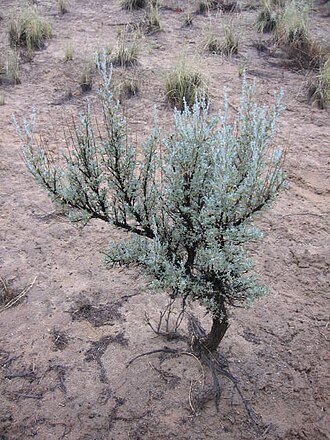
The defining shrub of the Intermountain West, perfuming millions of acres with its silvery, three-toothed evergreen leaves. Essential habitat for sage-grouse, pygmy rabbits, and pronghorn. Leaves season food and brew into a tea; the small oily seeds have been roasted and ground into a meal. Skin contact with this genus can cause dermatitis in sensitive people.
- Family
- Asteraceae
- Type
- tree
- Lifespan
- perennial
- Height
- 4–4 ft
- Spacing
- 3–8 ft apart
- Light
- sun
- Soil moisture
- dry, moist
- Soil pH
- acidic, neutral, alkaline
- Bloom
- June, July, August, September, October, November
- Bloom colors
- yellow
- Wildlife value
- songbirds, mammals
- Landscape uses
- specimen, hedge or screen
- Native states
- AZ, CA, CO, ID, MA, MT, ND, NE, NM, NV, OR, SD, UT, WA, WY
Related native plants
More Artemisia species
- California Sagebrush (Artemisia californica)
- White Sagebrush (Artemisia ludoviciana)
- Prairie Sagewort (Artemisia frigida)
- Sandhill Sage (Artemisia pycnocephala)
- Sand Sagebrush (Artemisia filifolia)
- Silver Sagebrush (Artemisia cana)